Abstract
The MOND acceleration scale \(a_0 \approx cH_0/2\pi\) and the cosmic gravitational decoherence rate \(\Gamma_{\mathrm{cosmic}}\approx g(1)H/4\pi\) are usually treated as unrelated numerical coincidences with the Hubble rate—one a fact about galactic dynamics, the other about the quantum-to-classical transition at the largest scales. We show they are the same quantity. Both are the Gibbons–Hawking temperature of the cosmological horizon, written as a frequency: the horizon clock \(\omega_\Lambda\equiv k_{\mathrm{B}}T_{\mathrm{dS}}/\hbar = H/2\pi\), which is also the rate of Tomita–Takesaki modular flow of the de Sitter vacuum. The MOND scale is this frequency carried by \(c\) (an acceleration), \(a_0 = c\,\omega_\Lambda= \kappa_{\mathrm{dS}}/2\pi\) with \(\kappa_{\mathrm{dS}}=cH\) the horizon surface gravity; the cosmic decoherence rate is the same frequency carried by a pure number, \(\Gamma_{\mathrm{cosmic}}= \tfrac12 g(1)\,\omega_\Lambda\). Consequently the two are locked at a parameter-free ratio, \(a_0/(c\,\Gamma_{\mathrm{cosmic}}) = 2/g(1) = 5.03\), in which every cosmological input cancels. The single non-trivial number \(g(1) = 1-(2/\pi)\operatorname{Si}(1) = 0.398\) is shown to be the sub-horizon fraction of the gravitational self-energy (Dirichlet) integral evaluated at one Hubble radius; the same ratio counts the modular “ticks” the universe takes to decohere. We place this in a horizon clock family—one clock \(\kappa/2\pi c\) per causal horizon—with intensive (per-mode) readings the acceleration scale (de Sitter: MOND) and the chaos/Lyapunov rate (de Sitter: \(\lambda=H\); black hole: the Maldacena–Shenker–Stanford bound), and extensive readings (summed over the \(S_{\mathrm{dS}}\) horizon modes) the cosmic decoherence rate and the dark-energy density, the latter via the exact equipartition identity \(S_{\mathrm{dS}}k_{\mathrm{B}}T_{\mathrm{dS}}= c^5/2GH = \rho_{\rm crit}c^2V_H\). We are explicit about what is established in the literature (the \(a_0\)–temperature identification: Klinkhamer–Kopp 2011; the apparent-horizon temperature at all epochs: Cai–Kim 2005; the de Sitter modular rate: Connes–Rovelli) and what is new here (the lock between cosmic decoherence and \(a_0\), and its consequences), and we state the falsifiable content honestly: current high-redshift rotation curves favour the constant-\(a_0\) branch, with which the framework is consistent.
Two numbers in contemporary gravitational physics sit suspiciously close to the Hubble rate. The first is Milgrom’s acceleration scale \[\begin{equation} a_0 \;\approx\; 1.2\times10^{-10}\ \mathrm{m\,s^{-2}} \;\approx\; \frac{cH_0}{2\pi}, \end{equation}\] the acceleration below which galactic rotation curves depart from the Newtonian prediction—the empirical core of MOND, and the scale a dark-matter halo must conspire to reproduce . The second is the rate at which the largest quantum superpositions conceivable—horizon-scale configurations of the cosmic wavefunction—lose coherence through their own gravity, \[\begin{equation} \Gamma_{\mathrm{cosmic}}\;\approx\; \frac{g(1)\,H}{4\pi} \;\approx\; \frac{H}{10\pi} \;\approx\; 7\times10^{-20}\ \mathrm{Hz}, \end{equation}\] derived within Quantum-Geometric Duality (QGD) on a de Sitter background , the cosmic-scale instance of the Diósi–Penrose gravitational decoherence rate . One belongs to galactic astronomy; the other to the foundations of quantum mechanics. They are normally not mentioned in the same sentence.
This paper’s claim is that they are two readings of a single clock. The cosmological horizon has a temperature, the Gibbons–Hawking temperature \[\begin{equation} T_{\mathrm{dS}}\;=\; \frac{\hbar H}{2\pi k_{\mathrm{B}}}, \end{equation}\] and any temperature defines a frequency \(k_{\mathrm{B}}T/\hbar\). For the horizon this is \[\begin{equation} \boxed{\;\omega_\Lambda\;\equiv\; \frac{k_{\mathrm{B}}T_{\mathrm{dS}}}{\hbar} \;=\; \frac{H}{2\pi}\;} \end{equation}\] which we call the horizon clock. We will show, with no new physical assumption beyond the two results above, that \[\begin{equation} a_0 \;=\; c\,\omega_\Lambda, \qquad\qquad \Gamma_{\mathrm{cosmic}}\;=\; \tfrac12\,g(1)\,\omega_\Lambda, \end{equation}\] so that the MOND scale is the horizon clock carried by \(c\) (a frequency becomes an acceleration) and the cosmic decoherence rate is the same clock carried by a pure number. The deep-sector puzzles of cosmic acceleration’s companion scale and of cosmic-scale decoherence are one piece of horizon thermodynamics.
The physical picture is the organizing thesis of QGD applied to the horizon itself: just as quantum mechanics and general relativity are read here as two projections of one quantum information, the horizon’s single thermodynamic frequency projects onto an acceleration scale (how gravity behaves) and onto a rate (how fast gravity decoheres). What looked like two coincidences with \(H_0\) is one fact about the horizon, seen twice.
The frequency \(\omega_\Lambda\) is not merely “a number built from a temperature.” It is the rate of the Tomita–Takesaki modular flow of the de Sitter vacuum—the Connes–Rovelli thermal time of the universe . For a KMS state at temperature \(T\), the modular automorphism group runs in a parameter \(s\) related to physical time by \(t = (\hbar/k_{\mathrm{B}}T)\,s = s/\omega_\Lambda\); the modular clock ticks at \(k_{\mathrm{B}}T/\hbar\). Recent explicit constructions of the de Sitter modular Hamiltonian confirm that, in the large-diamond limit, modular flow becomes static-patch time translation at exactly this rate . The \(2\pi\) in \(\omega_\Lambda= H/2\pi\) is therefore the thermal (KMS) period, the same \(2\pi\) that appears in every Unruh, Hawking, and Gibbons–Hawking temperature.
This furnishes a compact statement of the MOND scale. Any causal horizon with surface gravity \(\kappa\) has temperature \(T = \hbar\kappa/(2\pi ck_{\mathrm{B}})\), so the associated acceleration scale is \[\begin{equation} a_\star \;\equiv\; c\,\frac{k_{\mathrm{B}}T}{\hbar} \;=\; \frac{\kappa}{2\pi}. \end{equation}\] The de Sitter horizon has \(\kappa_{\mathrm{dS}}=cH\), whence \[\begin{equation} \boxed{\;a_0 \;=\; \frac{\kappa_{\mathrm{dS}}}{2\pi}\;=\;\frac{cH}{2\pi}\;} \end{equation}\] —the MOND acceleration is the de Sitter horizon’s surface gravity divided by \(2\pi\). (As a consistency check, a Rindler horizon of acceleration \(a\) gives \(a_\star = a/2\pi\), the inverse of the Unruh relation.) Equivalently, the de Sitter thermal mass \(\Delta m_{\mathrm{dS}}= k_{\mathrm{B}}T_{\mathrm{dS}}/c^2 = \hbar H/(2\pi c^2)\) has a Compton wavelength equal to the horizon circumference, \(\lambda_C(\Delta m_{\mathrm{dS}})=\hbar/(\Delta m_{\mathrm{dS}}c)=2\pi R_{\mathrm{H}}\), so that \[\begin{equation} a_0 \;=\; \frac{c^2}{2\pi R_{\mathrm{H}}} \;=\; \frac{c^2}{\lambda_C(\Delta m_{\mathrm{dS}})}: \end{equation}\] the MOND scale is the de Sitter thermal mass delocalised once around the horizon.
We note for completeness, and do not claim as new, that the identification \(a_0 = c\,k_{\mathrm{B}}T_{\mathrm{dS}}/\hbar = cH/2\pi\) is present in Klinkhamer and Kopp , who reach it from a holographic minimum-temperature argument; the qualitative \(a_0\sim cH\) goes back to Milgrom’s vacuum-effect proposal and appears in Verlinde’s emergent-gravity program . What follows—the lock to cosmic decoherence—is the new content.
The cosmic decoherence rate of QGD on de Sitter is \[\begin{equation} \Gamma_{\mathrm{cosmic}}\;=\; \frac{g(1)\,H}{4\pi}, \qquad g(x) \;=\; 1 - \frac{2}{\pi}\operatorname{Si}(x), \qquad g(1) = 0.3977, \label{eq:Gcos} \end{equation}\] where \(\operatorname{Si}\) is the sine integral and the form-factor argument is evaluated at the horizon scale (Section 5). Writing \(H/4\pi = \tfrac12\,\omega_\Lambda\) gives immediately \[\begin{equation} \Gamma_{\mathrm{cosmic}}\;=\; \tfrac12\,g(1)\,\omega_\Lambda, \end{equation}\] the same clock \(\omega_\Lambda\) as \(a_0 = c\omega_\Lambda\), now multiplied by the pure number \(g(1)/2 = 0.199\). Dividing the two relations, every cosmological input (\(H\), \(G\), \(c\), \(\hbar\)) cancels:
\[\begin{equation} \frac{a_0}{c\,\Gamma_{\mathrm{cosmic}}} \;=\; \frac{2}{g(1)} \;=\; \frac{2}{1-(2/\pi)\operatorname{Si}(1)} \;=\; 5.029 . \label{eq:lock} \end{equation}\]
This is a parameter-free internal constraint. A framework that explains the MOND scale with one piece of physics and cosmic decoherence with unrelated physics has two independent knobs here; QGD has one. Measuring \(a_0\) fixes \(\Gamma_{\mathrm{cosmic}}\) and vice versa.
The same number admits three readings, all equal to \(\omega_\Lambda/\Gamma_{\mathrm{cosmic}}\):
The lock (acceleration vs. rate): \(a_0 = 5.03\,c\,\Gamma_{\mathrm{cosmic}}\).
Modular ticks to decohere: the universe decoheres in \(\omega_\Lambda/\Gamma_{\mathrm{cosmic}}= 2/g(1) = 5.03\) ticks of its own thermal-time clock. Using the closed-form Bures–Fisher trajectory of QGD pure dephasing , \(d_B^2(t) = 2-\sqrt{2(1+e^{-\Gamma t})}\), at \(\Gamma t = 2/g(1)\) the cosmic state has covered \(99.2\%\) of its geometric distance from coherent to maximally mixed.
Hubble units: \(\Gamma_{\mathrm{cosmic}}^{-1} = (4\pi/g(1))H^{-1} = 31.6\,H^{-1} \approx 10\pi\,H^{-1}\), i.e. decoherence after \(\sim 10\pi\) e-folds—which is exactly five modular ticks, each tick being \(2\pi\) e-folds.
The lock is exact at a fixed cosmology. In the source papers \(a_0\) is quoted with \(H_0=70\) and \(\Gamma_{\mathrm{cosmic}}\) with \(H_0=67.4\) (Planck); the only thing that breaks the exact ratio between the two is precisely this \(70/67.4 \approx 1.039\)—the Hubble tension itself. There is no other slack.
Two of this framework’s results carry a factor \(2/\pi\): the Margolus–Levitin speed limit of Paper H, \(\Gamma_{\mathrm{ML}} = 2E_G/(\pi\hbar)\) , and the form-factor normalisation in Eq. [eq:Gcos]. It is tempting to call them two faces of one object. They are not: we show they share an origin but are provably distinct, and we identify exactly how they differ.
The QGD decoherence functional for a two-branch source is a mode integral whose integrand factorises into a space part and a time part : \[\begin{equation} \Gamma(t) \;\propto\; \int \frac{d^3k}{k^4\,\omega_k}\; \underbrace{\bigl(1-\cos \mathbf{k}\!\cdot\!\mathbf{d}\bigr)}_{\text{space}}\; \underbrace{\bigl(1-\cos \omega_k t\bigr)}_{\text{time}} . \end{equation}\] The \(3\)D angular average of the space factor is the spherical Bessel function \(1-j_0(kd) = 1-\sin(kd)/(kd)\), and its radial integral is the Dirichlet integral \[\begin{equation} \int_0^\infty j_0(kd)\,dk \;=\; \frac{\pi}{2d}, \end{equation}\] whose half-value \(\pi/2\) is the spatial \(\pi/2\). It sits inside \(E_G\): indeed \(E_G = (2GM^2/\pi d)\!\int_0^\infty j_0 = (2GM^2/\pi d)(\pi/2) = GM^2/d\). This \(\pi/2\) is an analytic constant, and it is deformable: an infrared cutoff \(k>k_H=1/R_{\mathrm{H}}\) replaces it by \(\pi/2-\operatorname{Si}(x)\)—precisely the form factor \(g(x)\) of Section 5.
The time factor instead governs orthogonalisation. For the two-branch case the overlap amplitude is \(\propto\cos(E_G t/2\hbar)\), orthogonal at the Fubini–Study quarter-turn \(\theta=\pi/2\); the Margolus–Levitin inequality \(1-\cos x \le (2/\pi)(x+\sin x)\) is tight at \(x=\pi\) (the two-level orthogonalisation point), which fixes the temporal \(2/\pi\). This \(\pi/2\) is a geometric constant (the angle from a ray to an orthogonal ray), and it is rigid: an infrared cutoff rescales the rate but never the orthogonality angle.
This furnishes a clean distinctness theorem. As functions of the cutoff scale, the spatial weight \(\partial_\Lambda P_{\rm space}\neq 0\) (it slides from \(\pi/2\) to \(0\) as \(g\)), while the orthogonalisation angle \(\partial_\Lambda P_{\rm time}=0\), with \(P_{\rm space}(\infty)=P_{\rm time}=\pi/2\). A function with nonzero derivative and one with zero derivative in the same variable are not the same function; the two \(\pi/2\)’s, equal only at zero cutoff, are distinct objects . The shared value is the coincidence that the Dirichlet integral and the Hilbert-space right angle are both \(\pi/2\).
This negative result is the physically useful one. The horizon edits the spatial \(\pi/2\) (turning \(E_G\) into \(g(x)E_G\)) but cannot touch the temporal \(\pi/2\) (the orthogonality angle is geometric). That is exactly why the cosmic rate is \(\Gamma_{\mathrm{cosmic}}= \tfrac12 g(1)\omega_\Lambda\): the horizon deforms the energy, not the rate-per-energy. The two hands of the clock move for different reasons—one analytic and horizon-edited, one geometric and untouchable—and that asymmetry is the structural origin of the \(g(1)\) in the lock \(2/g(1)\). The physically meaningful statement (Paper H) is that the Diósi–Penrose rate sits at the Margolus–Levitin scale—of order \(E_G/\hbar\), not the \(10^{35}\) below it of perturbative QFT. The exact factor in \(\Gamma_{\rm DP}/\Gamma_{\rm ML}=(E_G/\hbar)/(2E_G/\pi\hbar)=\pi/2\), however, is a definitional restatement—it is the ratio of the \(1/e\) decay time to the orthogonalisation time (Paper H), carrying no information about whether the two \(\pi/2\)’s are the same object. The cutoff argument above settles that they are not.
The distinctness has an experimental face. A BMV/QGEM experiment entangles two masses through their mutual gravity; the two-qubit concurrence is \(C(t)=|\sin(\Phi/2)|\) with entangling phase \(\Phi=\Delta E_{\rm BMV}\,t/\hbar\), maximal at \(\Phi=\pi\). The same mutual energy \(\Delta E_{\rm BMV}\) that entangles the pair also mutually decoheres it (the entanglement–decoherence duality of Paper I), so the maximal-entanglement time and the mutual-decoherence time obey, for any geometry, \[\begin{equation} \frac{\tau_{\rm BMV}(\text{max})}{\tau_{\rm dec}^{\rm mutual}} = \frac{\pi\hbar/\Delta E_{\rm BMV}}{2\hbar/\Delta E_{\rm BMV}} = \frac{\pi}{2}, \end{equation}\] the Fubini–Study quarter-turn—identical to the Margolus–Levitin orthogonalisation time, and verified geometry-independent for concrete parameters spanning \(10^{-15}\)–\(10^{-13}\) kg (§X). This \(\pi/2\) is the temporal, rigid one: the lab is Minkowski (\(x=Hd/c\approx0\), \(g\to1\)), so the spatial Dirichlet \(\pi/2\) is undeformed and only the temporal \(\pi/2\) is exposed. Thus a lab entanglement experiment measures the temporal sibling (the quarter-turn, geometry-fixed and horizon-untouchable), while the de Sitter form factor \(g(1)=1-(2/\pi)\operatorname{Si}(1)\) measures the spatial sibling (the Dirichlet integral, truncated by the horizon). The shared structure between lab and cosmos is the temporal \(\pi/2\) (geometric, the same everywhere); the entire difference is the spatial form factor (\(g=1\) in the lab, \(0.398\) at the horizon)—which is exactly why the cosmic suppression in \(\Gamma_{\mathrm{cosmic}}=\tfrac12 g(1)\omega_\Lambda\) is carried by \(g(1)\) alone.
We note a concrete and uncomfortable consequence, derived elsewhere and flagged here: while the mutual channel obeys the clean \(\pi/2\), the single-particle self-decoherence is a different, much larger energy (\(E_G^{\rm self}\sim Gm^2/R\), set by the particle radius \(R\), versus \(\Delta E_{\rm BMV}\sim 2Gm^2\Delta x^2/d^3\)). Their ratio \(E_G^{\rm self}/\Delta E_{\rm BMV}\sim 0.6\,d^3/(R\Delta x^2)\sim10^{2\text{--}3}\) for realistic parameters means that, if QGD’s \(G^1\) self-decoherence is real, each superposition self-decoheres \(10^{2}\)–\(10^{3}\times\) faster than the BMV entanglement builds (and geometrically unavoidably so, since \(\tau_{\rm dec}^{\rm self}>\tau_{\rm BMV}\) would need \(R>\Delta x\)). BMV is thus, within QGD, also a \(G^1\)-vs-\(G^2\) discriminator: a positive entanglement result would constrain the very \(G^1\) self-decoherence scaling the framework rests on. Details and caveats (cutoff choice, pointer basis) are in the BMV note .
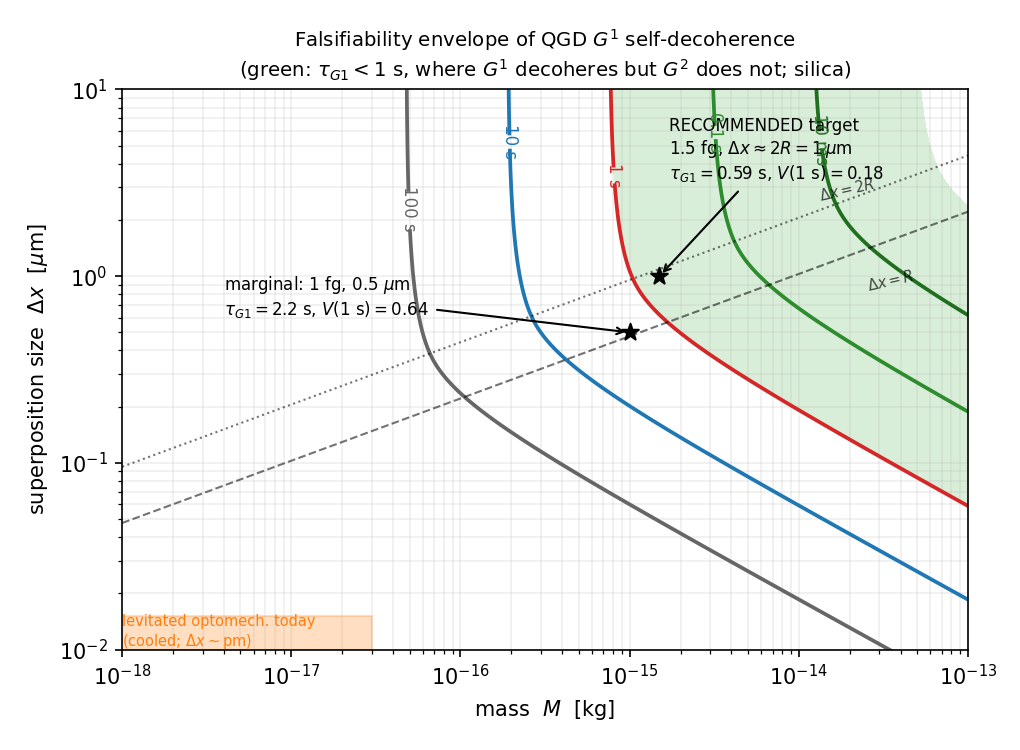
The same self-decoherence gives a sharp, near-term, single-particle target (Fig. 1). For a uniform sphere the exact self-energy is \(E_G(\Delta x)=(GM^2/R)[\tfrac12 s^2-\tfrac{3}{16}s^3+\tfrac{1}{160}s^5]\) for \(s=\Delta x/R\le2\), saturating at \(1.2\,GM^2/R\) for \(\Delta x\gtrsim2R\). The decoherence time \(\tau_{G1}=\hbar/E_G\sim M^{-5/3}\) falls below a second only for \(M\gtrsim M_\star\approx7\times10^{-16}\) kg (a femtogram, \(R\sim0.4\,\mu\)m). A silica sphere of \(M=1.5\) fg in a \(\Delta x\approx1\,\mu\)m superposition held for \(1\) s gives \(\tau_{G1}=0.59\) s and visibility \(V=0.18\), versus \(V\simeq1\) for \(G^2\)—an unmistakable discriminant, requiring cryogenic extreme-high vacuum (\(\sim10^{-15}\) mbar) to suppress gas collisions below \(\Gamma_{G1}\). The first \(\gtrsim\)femtogram solid-object superposition held for \(\sim1\) s thus tests the \(G^1\) scaling directly .
Everything in Eq. [eq:lock] is rational geometry except \(g(1)\). Its meaning is concrete. The gravitational self-energy of the two-branch source is the Dirichlet integral above; on de Sitter the modes with \(k<k_H = 1/R_{\mathrm{H}}\) are super-horizon and cannot drive decoherence within a Hubble time, so the surviving energy is the same integral cut at \(k_H\): \[\begin{equation} E_G^{\mathrm{dS}}(x) \;\propto\; \int_{k_H}^\infty \frac{\sin(kd)}{kd}\,dk \;=\; \frac{1}{d}\Bigl(\frac{\pi}{2}-\operatorname{Si}(x)\Bigr), \qquad x = k_H d = \frac{Hd}{c}. \end{equation}\] The form factor is the ratio of surviving to total energy, \[\begin{equation} g(x) \;=\; \frac{E_G^{\mathrm{dS}}(x)}{E_G^{\mathrm{Mink}}} \;=\; \frac{\tfrac{\pi}{2}-\operatorname{Si}(x)}{\tfrac{\pi}{2}} \;=\; 1-\frac{2}{\pi}\operatorname{Si}(x), \end{equation}\] so the \(2/\pi\) is simply the inverse Dirichlet integral, \(\operatorname{Si}(x)\) is the super-horizon energy removed, and \(x=1\) is forced because the horizon mode has \(d=R_{\mathrm{H}}\). Numerically, at \(x=1\) the super-horizon piece \(\operatorname{Si}(1)=0.946\) is \(60.2\%\) of \(\pi/2\), leaving
\[\begin{equation} g(1) \;=\; \frac{\tfrac{\pi}{2}-\operatorname{Si}(1)}{\tfrac{\pi}{2}} \;=\; 0.398 \;=\; \text{sub-horizon fraction of the gravitational self-energy at } d=R_{\mathrm{H}}. \end{equation}\]
The merge number then decomposes transparently, \[\begin{equation} \frac{2}{g(1)} \;=\; \underbrace{\frac{4\pi}{2\pi}}_{\substack{\text{horizon area}\\/\text{KMS period}}} \Big/\; \underbrace{g(1)}_{\substack{\text{sub-horizon energy}\\\text{fraction at }R_{\mathrm{H}}}} \;=\; \frac{\pi}{\tfrac{\pi}{2}-\operatorname{Si}(1)} \;=\; 5.029 : \end{equation}\] the universe decoheres in \(\sim 5\) modular ticks because the horizon area carries a factor \(2\) over the thermal period and only \(\sim 40\%\) of horizon-scale gravitational binding survives the super-horizon cut. The value is transcendental, not a hidden integer; the closeness \(g(1)\approx 2/5\) (to \(0.6\%\)) is a coincidence.
The closed form \(g(x)=1-(2/\pi)\operatorname{Si}(x)\) is non-monotonic and becomes negative for \(x\gtrsim 1.9\), because \(\operatorname{Si}\) overshoots \(\pi/2\). A negative rate is unphysical: the cut-Dirichlet construction is valid only for \(x\le 1\) (sub-horizon to horizon). The framework uses only \(g(1)\), which is safely positive; the super-horizon tail requires the infrared-complete de Sitter mode sum, not this formula.
Because both \(a_0\) and \(\Gamma_{\mathrm{cosmic}}\) are the one clock \(\omega_\Lambda(z)\), and the decoherence form factor is pinned at \(x = HR_{\mathrm{H}}/c = 1\) at every epoch (for a spatially flat universe the apparent-horizon radius is \(R_{\mathrm{H}}= c/H\) exactly at all times ), the lock is redshift-rigid: provided \(a_0\) and \(\Gamma_{\mathrm{cosmic}}\) are referred to the same horizon \(H\), \[\begin{equation} \frac{a_0(z)}{c\,\Gamma_{\mathrm{cosmic}}(z)} \;=\; \frac{2}{g(1)} \quad\text{for all } z . \end{equation}\] Every power of \(H(z)\) cancels.
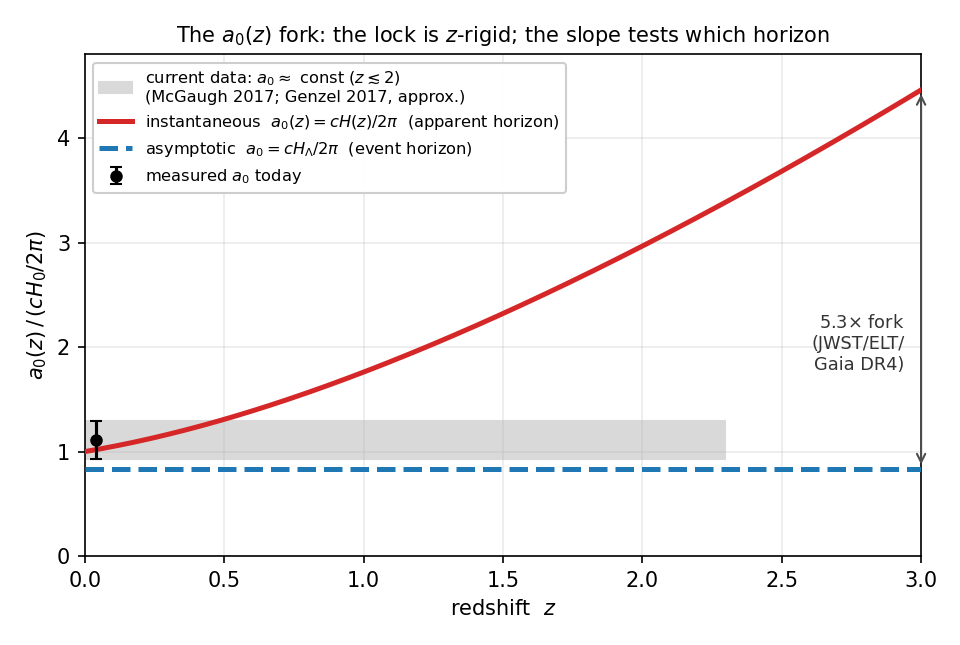
The lock fixes the ratio; it does not by itself fix which horizon sets the shared \(H\) (Fig. 2). Two readings compete:
the instantaneous apparent-horizon rate \(H(z)\), giving an evolving \(a_0(z)=cH(z)/2\pi\) (a factor \(\sim 3\) larger at \(z=2\)); and
the asymptotic event-horizon rate \(H_\Lambda = H_0\sqrt{\Omega_\Lambda}\), giving a constant \(a_0\).
We initially expected the decoherence sector to force the instantaneous branch, since its modes are physical horizon modes at each epoch. This over-reached, and the data point the other way: high-redshift rotation curves find \(a_0\) consistent with constant over \(z=0\)–\(2\) and exclude strong evolution. The honest reading is that the de Sitter decoherence calculation is most naturally referred to the asymptotic (event-horizon) rate \(H_\Lambda\); then both legs are constant, the lock holds trivially, and the framework is consistent with the data. Milgrom frames this same \(a_H=cH(t)\) versus \(a_\Lambda=c\sqrt{\Lambda/3}\) choice as open. The robust prediction of this work is the ratio \(2/g(1)\), not a particular \(a_0(z)\) law; the instantaneous branch remains a live, mildly disfavoured possibility that JWST/ELT and Gaia DR4 can settle.
The construction generalises: every causal horizon carries one clock \(\omega = \kappa/2\pi c\), surfacing three ways.
| reading | de Sitter | black hole |
|---|---|---|
| acceleration scale \(a_\star=c\omega=\kappa/2\pi\) | \(a_0=cH/2\pi\) (MOND) | \(c^4/8\pi GM\) |
| chaos / Lyapunov rate \(\lambda=2\pi\omega=\kappa/c\) | \(H\) (de Sitter Lyapunov) | \(2\pi k_{\mathrm{B}}T_H/\hbar\) (MSS bound) |
| decoherence rate \(\sim O(1)\,\omega\) | \(\tfrac12 g(1)\omega_\Lambda= \Gamma_{\mathrm{cosmic}}\) | \(\sim\omega_H\) (Hawking/scrambling) |
Two rows are textbook: the de Sitter Lyapunov exponent is exactly \(H\) , and the black-hole row is the Maldacena–Shenker–Stanford chaos bound \(\lambda\le 2\pi k_{\mathrm{B}}T/\hbar\), saturated at horizons . The new content is the third row and its lock to the first: the same clock \(\omega\) that sets the chaos bound (via \(2\pi\)) and the acceleration scale (via \(c\)) also sets the decoherence rate (via an \(O(1)\) number). Black-hole chaos, the MOND scale, and cosmic decoherence are three projections of one horizon clock.
The readings above are all intensive—properties of a single horizon mode of frequency \(\omega_\Lambda\). The horizon also carries \(S_{\mathrm{dS}}=\pi c^5/(\hbar G H^2)\) such modes, and summing over them yields the framework’s two large-scale readings. The total horizon thermal energy is, exactly, \[\begin{equation} S_{\mathrm{dS}}\,k_{\mathrm{B}}T_{\mathrm{dS}}\;=\; \frac{c^5}{2GH} \;=\; \rho_{\rm crit}\,c^2\,V_H , \label{eq:equipartition} \end{equation}\] the critical energy of the Hubble volume (holographic equipartition, the de Sitter case of Padmanabhan’s relation ; verified to ten digits in §X). Holographic dark energy writes \(\rho_{\rm DE}=\alpha c^2H^2/G\) with \(\alpha=3\Omega_{\rm DE}/8\pi\); combining with Eq. [eq:equipartition] gives \(\rho_{\rm DE}=\Omega_{\rm DE}\,(S_{\mathrm{dS}}k_{\mathrm{B}}T_{\mathrm{dS}})/(c^2V_H)\), so the dark-energy density is the fraction \(\Omega_{\rm DE}\) of the horizon’s thermal energy density, with the pure–de Sitter coefficient \(\alpha_\infty=3/8\pi=0.119\) fixed by the clock. The cosmic decoherence rate is likewise an extensive sum: \(\Gamma_{\mathrm{cosmic}}= S_{\mathrm{dS}}\times(\text{per-mode rate}) = g(1)H/4\pi\) (Paper N). Thus
| intensive (per mode, \(\omega_\Lambda\)) | extensive (\(\times\,S_{\mathrm{dS}}\)) | |
|---|---|---|
| energy / acceleration | \(a_0 = c\omega_\Lambda\) (MOND) | \(S_{\mathrm{dS}}k_{\mathrm{B}}T_{\mathrm{dS}}= c^5/2GH\) (dark energy) |
| rate | \(\lambda = 2\pi\omega_\Lambda= H\) (chaos) | \(g(1)H/4\pi = \Gamma_{\mathrm{cosmic}}\) (decoherence) |
Dark energy and cosmic decoherence are siblings—both extensive, both carrying the holographic mode count \(S_{\mathrm{dS}}\)—while MOND and chaos are the intensive, per-mode readings. The horizon is one clock with \(S_{\mathrm{dS}}\) hands; read per hand, it gives the acceleration scale and the chaos bound, read over all hands, the dark-energy density and the cosmic decoherence rate. We claim no solution to the cosmological constant problem: the present \(\Omega_{\rm DE}\) (equivalently, why we live near the matter/dark-energy transition) is not explained here, exactly as the decoherence reading does not explain \(g(1)\). Only the structure and the asymptotic \(\alpha_\infty=3/8\pi\) are clock-fixed—and the latter is the framework’s genuine GSL/event-horizon attractor (the de Sitter limit \(\Omega_{\rm DE}\to1\), \(HR_h\to1\) ), not merely a limit. We note for the record that the near-coincidence \(\alpha\approx 1/4\pi\) at \(\Omega_{\rm DE}=2/3\) is not a fixed point: \(\Omega_{\rm DE}=2/3\) is no dynamical landmark (it gives \(q=-1/2\); acceleration onset is \(q=0\) at \(\Omega_{\rm DE}=1/3\), de Sitter is \(q=-1\) at \(\Omega_{\rm DE}=1\)), and \(1/4\pi=\tfrac23\cdot 3/8\pi\) carries no independent meaning.
The identification \(a_0 = ck_{\mathrm{B}}T_{\mathrm{dS}}/\hbar = cH/2\pi\) ; \(a_0\sim cH\) as a de Sitter/vacuum scale ; the apparent-horizon temperature \(\hbar H/2\pi k_{\mathrm{B}}\) valid at all flat-FRW epochs ; the de Sitter modular-flow rate \(H/2\pi\) ; the chaos bound ; the de Sitter Lyapunov exponent .
(i) The lock between the cosmic decoherence rate and the MOND scale as one \(\omega_\Lambda\), Eq. [eq:lock], with its three equal readings; (ii) the identity \(a_0 = c^2/2\pi R_{\mathrm{H}}\) (Compton wavelength of the de Sitter thermal mass equals the horizon circumference); (iii) the reading of \(g(1)\) as the sub-horizon fraction of the gravitational self-energy, and the resulting decomposition of \(2/g(1)\); (iv) the proven distinctness of the two \(\pi/2\)’s (speed limit vs. form factor) via their opposite cutoff response, and the reading of a lab BMV experiment and the cosmic form factor as measurements of the temporal and spatial siblings respectively; (v) the horizon clock family with decoherence as a reading, and its intensive/extensive structure placing dark energy (via holographic equipartition) and cosmic decoherence as the two extensive readings. No prior work we are aware of links a gravitational or cosmological decoherence rate to \(a_0\), nor reads the holographic dark-energy coefficient as the extensive face of the same clock. We do not claim to solve the cosmological constant problem: the present \(\Omega_{\rm DE}\) is unexplained, only the structure and \(\alpha_\infty=3/8\pi\) are clock-fixed.
The robust prediction is the locked ratio \(a_0/(c\Gamma_{\mathrm{cosmic}}) = 2/g(1)\): the MOND scale and the cosmic decoherence normalisation are not independent. The cosmic decoherence rate itself (\(\sim 10^{-19}\) Hz) is not directly observable; the observable leg is \(a_0\) and its possible redshift evolution. A measured \(a_0(z)\) tracking the instantaneous \(H(z)\) would favour the apparent-horizon branch; the present constraint of approximate constancy favours the event-horizon branch, with which the framework is consistent. The framework would be stressed—though not the lock itself—if \(a_0\) were found to depend on a scale unrelated to any horizon.
The acceleration scale at which galaxies stop obeying Newton, and the rate at which the universe as a whole goes classical, are the same de Sitter horizon frequency \(\omega_\Lambda= k_{\mathrm{B}}T_{\mathrm{dS}}/\hbar = H/2\pi\), read once as an acceleration and once as a rate, and locked at \(a_0/(c\Gamma_{\mathrm{cosmic}}) = 2/g(1) = 5.03\). The one non-trivial number in that ratio is the fraction of horizon-scale gravitational binding that survives the super-horizon cut. Whether the shared horizon is the instantaneous apparent horizon or the asymptotic event horizon is an open, data-driven question; the ratio is not. In the language of Quantum-Geometric Duality, the cosmological horizon has a single clock, and dark-sector phenomenology and cosmic decoherence are two of its hands.
Data and reproducibility. Every numerical claim in
this paper is recomputed from CODATA constants by the verification
harness TOOLS/verify-paper-numerics.py (section X), which
checks the lock, the energy-ratio reading of \(g(1)\), the surface-gravity and
Compton-circumference identities, the de Sitter Lyapunov identity, and
the chaos-bound row to machine precision.
99
M. Sperzel, Cosmic Gravitational Decoherence on a de Sitter Background, Quantum-Geometric Duality Series, Paper N (2026).
M. Sperzel, Information-Theoretic Bounds on Gravitational Decoherence Rates, Quantum-Geometric Duality Series, Paper H (2026).
M. Sperzel, Gravitational Decoherence at \(O(G)\): The Wheeler–DeWitt Constraint on the Feynman–Vernon Influence Functional, Quantum-Geometric Duality Series, Paper K (2026).
M. Sperzel, The Exact Coherent-State Decoherence Functional (supporting derivation), Quantum-Geometric Duality Series (2026).
M. Sperzel, QGD Decoherence as Brownian Motion in Bures–Fisher Geometry (supporting derivation), Quantum-Geometric Duality Series (2026).
M. Sperzel, The Two \(\pi/2\)’s of Gravitational Decoherence: Shared Origin, Distinct Objects (supporting derivation), Quantum-Geometric Duality Series (2026).
M. Sperzel, Holographic Dark Energy in Quantum-Geometric Duality, Quantum-Geometric Duality Series, Paper B (2026).
T. Padmanabhan, Thermodynamical aspects of gravity: new insights, Rep. Prog. Phys. 73, 046901 (2010). doi:10.1088/0034-4885/73/4/046901
M. Milgrom, A modification of the Newtonian dynamics as a possible alternative to the hidden mass hypothesis, Astrophys. J. 270, 365 (1983). doi:10.1086/161130
S. McGaugh, F. Lelli, and J. Schombert, Radial acceleration relation in rotationally supported galaxies, Phys. Rev. Lett. 117, 201101 (2016). doi:10.1103/PhysRevLett.117.201101
M. Milgrom, The modified dynamics as a vacuum effect, Phys. Lett. A 253, 273 (1999). doi:10.1016/S0375-9601(99)00077-8 [arXiv:astro-ph/9805346]
F. R. Klinkhamer and M. Kopp, Entropic gravity, minimum temperature, and modified Newtonian dynamics, Mod. Phys. Lett. A 26, 2783 (2011). doi:10.1142/S0217732311037011 [arXiv:1104.2022]
E. Verlinde, Emergent gravity and the dark universe, SciPost Phys. 2, 016 (2017). doi:10.21468/SciPostPhys.2.3.016 [arXiv:1611.02269]
M. Milgrom, The \(a_0\)–cosmology connection in MOND, arXiv:2001.09729 (2020). arXiv:2001.09729
R. Genzel et al., Strongly baryon-dominated disk galaxies at the peak of galaxy formation ten billion years ago, Nature 543, 397 (2017). doi:10.1038/nature21685
G. W. Gibbons and S. W. Hawking, Cosmological event horizons, thermodynamics, and particle creation, Phys. Rev. D 15, 2738 (1977). doi:10.1103/PhysRevD.15.2738
R.-G. Cai and S. P. Kim, First law of thermodynamics and Friedmann equations of Friedmann–Robertson–Walker universe, J. High Energy Phys. 2005(02), 050 (2005). doi:10.1088/1126-6708/2005/02/050 [arXiv:hep-th/0501055]
D. Anninos, De Sitter musings, Int. J. Mod. Phys. A 27, 1230013 (2012). doi:10.1142/S0217751X1230013X [arXiv:1205.3855]
A. Connes and C. Rovelli, Von Neumann algebra automorphisms and time–thermodynamics relation in generally covariant quantum theories, Class. Quantum Grav. 11, 2899 (1994). doi:10.1088/0264-9381/11/12/007
K. Farnsworth, M. J. Kang, and J. Sorce, Modular Hamiltonians for de Sitter diamonds, arXiv:2308.14797 (2023). arXiv:2308.14797
V. Chandrasekaran, R. Longo, G. Penington, and E. Witten, An algebra of observables for de Sitter space, J. High Energy Phys. 2023, 082 (2023). doi:10.1007/JHEP02(2023)082
N. Margolus and L. B. Levitin, The maximum speed of dynamical evolution, Physica D 120, 188 (1998). doi:10.1016/S0167-2789(98)00054-2
J. Maldacena, S. H. Shenker, and D. Stanford, A bound on chaos, J. High Energy Phys. 2016, 106 (2016). doi:10.1007/JHEP08(2016)106
S. Bose, A. Mazumdar, G. W. Morley, H. Ulbricht, M. Toroš, M. Paternostro, A. Geraci, P. Barker, M. S. Kim, and G. Milburn, Spin entanglement witness for quantum gravity, Phys. Rev. Lett. 119, 240401 (2017). doi:10.1103/PhysRevLett.119.240401
C. Marletto and V. Vedral, Gravitationally induced entanglement between two massive particles is sufficient evidence of quantum effects in gravity, Phys. Rev. Lett. 119, 240402 (2017). doi:10.1103/PhysRevLett.119.240402
L. Diósi, A universal master equation for the gravitational violation of quantum mechanics, Phys. Lett. A 120, 377 (1987). doi:10.1016/0375-9601(87)90681-5
R. Penrose, On gravity’s role in quantum state reduction, Gen. Relat. Gravit. 28, 581 (1996). doi:10.1007/BF02105068
ORCID: 0009-0000-6252-3155.
Email: me@marcsperzel.com↩︎